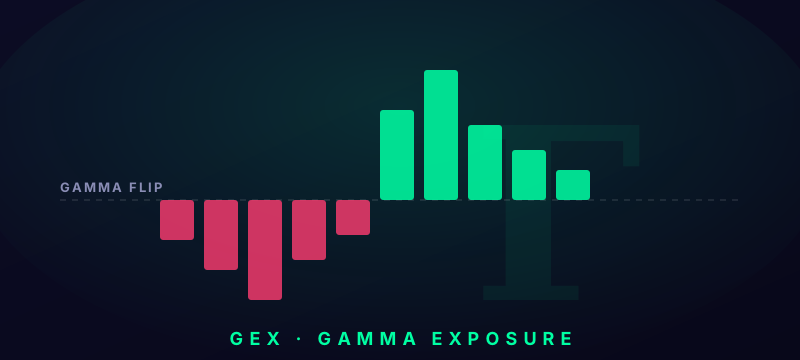
What Is GEX?
GEX — Gamma Exposure — is a measure of how much gamma risk options dealers are carrying across all open contracts on a given underlying. It answers a simple but powerful question: are dealers forced to buy when the market rises, or sell?
The answer to that question explains a large portion of intraday price behavior that has nothing to do with news, fundamentals, or technicals.
How GEX Is Calculated
When a dealer sells a call option to a buyer, the dealer is short gamma. To stay hedged, the dealer must:
- Buy the underlying as the stock rises (delta increases, dealer needs more stock to stay neutral)
- Sell the underlying as the stock falls (delta decreases, dealer needs less stock)
This is the opposite of what a momentum trader does. The dealer is always fading the move — buying dips, selling rips — when short gamma.
GEX aggregates this across all strikes and expirations:
- Positive GEX → dealers are net long gamma → they fade moves → volatility is suppressed
- Negative GEX → dealers are net short gamma → they chase moves → volatility is amplified
The GEX map on gammaflowpulse displays this exposure by strike price, so you can see exactly where the largest concentrations sit.
Positive GEX — The Pinning Regime
When GEX is strongly positive, dealers own more gamma than they've sold. Their hedging behavior acts as a natural stabilizer:
- Market rises → dealer delta increases → dealer sells stock to rebalance
- Market falls → dealer delta decreases → dealer buys stock to rebalance
The result is a mean-reverting environment. Price tends to get pinned near the strike with the highest positive gamma. Breakouts are difficult — every attempt to push price higher gets sold by dealer hedging flows.
What this looks like in practice:
- Tight intraday range despite news or macro catalysts
- Rapid snap-backs after brief spikes or drops
- Price gravitating toward a specific level (often a round number with large open interest)
Positive GEX regimes favor range-bound strategies — selling premium, iron condors, mean-reversion scalps.
Negative GEX — The Trending Regime
When GEX is negative, dealers are net short gamma. Their hedging now amplifies every move:
- Market rises → dealer delta decreases → dealer buys stock to rebalance
- Market falls → dealer delta increases → dealer sells stock to rebalance
Dealers are now momentum traders by necessity. Every move begets more of the same move.
What this looks like in practice:
- Fast, sustained directional moves with little snap-back
- Volatility spikes — both realized and implied
- VIX expansion often accompanies deeply negative GEX readings
- Stops get run, breakouts follow through
Negative GEX regimes favor directional strategies — buying options, momentum entries, trend following.
The Gamma Flip — The Most Important Level on the Map
The gamma flip is the price level where total GEX crosses from positive to negative (or vice versa). It is the single most important reference point on the GEX map.
- Above the gamma flip → GEX is positive → suppressed volatility, mean-reverting
- Below the gamma flip → GEX is negative → amplified volatility, trending
The flip level acts like a regime switch. When price is comfortably above it, the market tends to chop. When price breaks below it, volatility can accelerate quickly as dealers shift from dampening to amplifying flows.
How to use it:
- If price is above the flip and approaching it from above — be alert for a volatility expansion if it breaks
- If price is below the flip and reclaims it — the move may stall and reverse as dealers shift back to dampening mode
- The flip level often aligns with key technical levels — this is not coincidence, it is the same open interest that draws both
Call Wall and Put Wall
Beyond the gamma flip, the GEX map highlights two other key levels:
Call Wall — the strike with the largest positive gamma from calls. This is where dealer buying pressure is strongest on rallies. Price often stalls here as dealers sell into the move. The call wall acts as a ceiling in positive GEX environments.
Put Wall — the strike with the largest negative gamma from puts. This is where dealer selling pressure is strongest on declines. The put wall can accelerate a downmove as price approaches it, then act as a magnet once breached.
Together, the call wall and put wall define the expected range for a given session. When price is between them, the GEX regime tends to be stable. When price breaks through either, the next GEX level becomes the new target.
0DTE and the Gamma Explosion
Zero-days-to-expiration (0DTE) options have the highest gamma of any contract. A near-the-money 0DTE option can have gamma 10–20x higher than a weekly option at the same strike.
This creates intense hedging flows concentrated in the last hours of trading:
- Large 0DTE call positioning creates strong positive GEX near the strike → pinning behavior into the close
- Unexpected moves through 0DTE strikes create rapid dealer re-hedging → sharp acceleration
- The 0DTE gamma flip may differ from the aggregate GEX flip — watch both
On SPX, where 0DTE volume now exceeds 50% of daily options flow, these effects are strongest. The gammaflowpulse 0DTE Heatmap is specifically designed to show this intraday gamma distribution.
Practical GEX Checklist for Intraday Trading
Before the open, check:
- Is total GEX positive or negative? Sets the volatility regime expectation
- Where is the gamma flip? Key level to watch for regime change
- Where are the call wall and put wall? Defines the expected range
- Is price above or below the flip heading into the session? Determines whether to fade or follow moves
During the session:
- Price approaching the call wall from below → consider fading or tightening targets
- Price breaking below the put wall → expect acceleration, not mean-reversion
- Price crossing the gamma flip intraday → regime has changed, adjust strategy
What GEX Does Not Tell You
GEX is a structural input, not a timing signal. It does not tell you:
- Which direction the market will move
- When a move will start
- How long a regime will last
It tells you the character of the move when it comes — whether it will be contained or explosive. Use GEX alongside price action and other inputs, not as a standalone signal.