What Is CHEX?
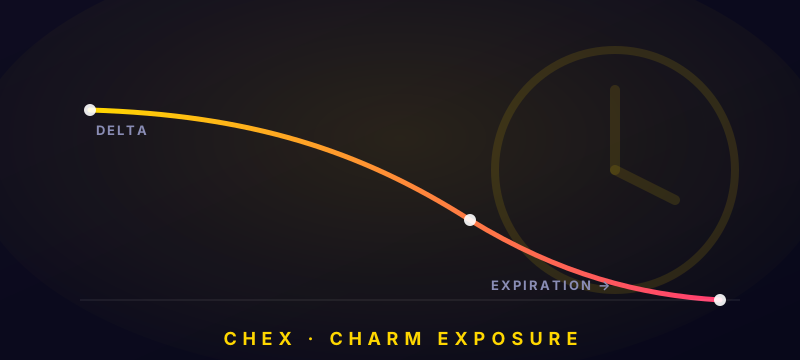
CHEX — Charm Exposure — measures the aggregate charm risk dealers carry across all open options contracts. Charm is the rate at which an option's delta decays over time, independent of any price or volatility move.
As each hour passes, every option's delta shifts slightly toward its expiration value:
- Out-of-the-money options drift toward delta zero (they become less likely to expire in the money)
- In-the-money options drift toward delta ±1 (they become more certain to expire in the money)
Dealers must rebalance their hedges to account for this drift. That rebalancing — driven purely by the passage of time — is what CHEX captures.
How Charm Creates Mechanical Flows
When dealers sold a call option, they bought stock to hedge (they're short delta, so they bought to neutralize). As that call's delta decays toward zero over time:
- The dealer needs less stock to stay hedged
- They sell the stock they no longer need
- This selling has nothing to do with price action — it is purely time-driven
Multiply this across all the calls and puts in the open interest, and you get sustained, mechanical flows throughout the trading day — strongest in the final hours before expiration.
Positive and Negative CHEX
Positive CHEX — charm is creating net buying pressure as time passes
This happens when dealers are net short puts (sold puts, hedged by selling stock). As put deltas decay toward zero, dealers need to buy back the stock they sold short. This creates a mechanical upward drift.
Negative CHEX — charm is creating net selling pressure as time passes
This happens when dealers are net short calls (sold calls, hedged by buying stock). As call deltas decay toward zero, dealers sell the stock they no longer need to hold. This creates a mechanical downward drift or pin at a strike level.
The Expiration Pin — CHEX in Action
The most visible CHEX effect is the expiration pin — where price gravitates toward a heavily populated strike near the close of an expiration day.
Here is the mechanics:
- A large amount of open interest sits at, say, the 5,000 strike in SPX calls
- With those calls near expiration, their delta is highly sensitive to whether price is above or below 5,000
- If price is just above 5,000, calls are slightly in the money → dealers are long delta → they sell
- If price dips just below 5,000, calls go out of the money → dealers suddenly don't need as much stock → they sell more
- The net effect pulls price toward 5,000 and keeps it there into the close
This is why experienced traders say "price pins to the strike" on expiration — it is not mystical, it is charm-driven mechanical hedging.
When CHEX Matters Most
Friday afternoons
Weekly options expire every Friday. Charm effects ramp up through the morning and peak in the final 90 minutes of trading. The largest open interest strike on weekly SPX or SPY options is often where price gravitates.
0DTE sessions
Zero-days-to-expiration options have extreme charm — delta can shift dramatically in a single hour. CHEX flows from 0DTE contracts are now a major factor in intraday SPX price behavior, particularly in the 2:00–4:00 PM ET window.
Monthly expirations (third Friday)
The largest open interest of the month expires. CHEX effects are strongest, and the pin behavior is most reliable. Moves through heavily populated strikes late in the day often snap back quickly as charm rebalancing kicks in.
Quiet, low-vol days
When GEX and VEX are quiet (low vol, no events), charm flows are proportionally more significant. What looks like random afternoon drift is often CHEX at work.
Reading CHEX on gammaflowpulse
The CHEX map displays charm exposure by strike price. Key readings:
Large negative CHEX at a strike near current price
Dealers are selling stock as call deltas decay. Expect selling pressure or a ceiling effect. If price is below this level, the charm-driven selling makes it harder to rally through.
Large positive CHEX at a strike near current price
Dealers are buying stock as put deltas decay. Expect buying support. This often explains why price stabilizes or drifts higher in the final hour even without any bullish catalyst.
CHEX concentration at round numbers
Round strikes (5,000, 500, 100) attract the most open interest and therefore the most charm exposure. Watch these levels most closely on expiration days.
CHEX Through the Trading Day
Charm flows are not constant through the session. They accelerate as expiration approaches:
- Pre-market to 10 AM — charm effects are mild, GEX and DEX dominate
- 10 AM to 2 PM — charm builds gradually, especially for same-day (0DTE) expirations
- 2 PM to 4 PM ET — charm is at maximum intensity for weeklies and 0DTE contracts. This is when pin behavior is strongest and directional breakouts are hardest to sustain
If you are trading the final two hours of an expiration Friday, CHEX should be your first reference — not technicals.
Practical CHEX Checklist
On expiration days (especially Fridays):
- Check CHEX map before the open — where is the largest charm concentration?
- Note whether it is positive (buying pressure) or negative (selling pressure)
- That strike is your primary pin target for the close
Intraday (2 PM onward):
- Is price drifting toward the largest CHEX strike? That is charm, not momentum — do not chase it
- Is price being rejected at a negative CHEX strike? Dealer charm selling is the likely cause — wait for it to exhaust before fading
After expiration:
- Large CHEX positions expire with the contracts. The following Monday's open interest profile resets — check the new GEX and DEX maps fresh.